
Key words :
biofuel
,efficiency
,nuclear
,offshore drilling
,peak oil
,renewable energy
,speculation
,y2k
The Influence of "Peak Oil"
15 Aug, 2009 01:49 pm
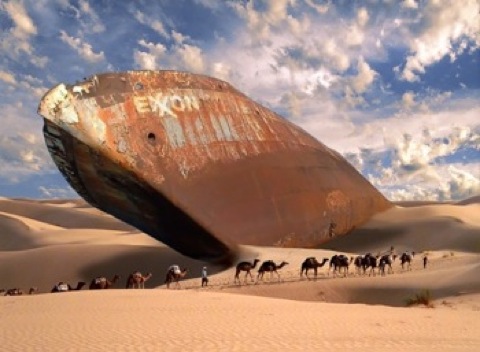
An article in the Washington Post this weekend, together with a must-read interview in The Independent, a paper I used to read regularly when I lived in London, reminded me of an observation I made several years ago concerning the similarities between Peak Oil and Y2K. Having spent a fair amount of time in my former corporate role planning for the serious outcomes the latter might have produced, I don't intend this as a slam on the former. Without rehashing the technical arguments behind either phenomenon, it's worth spending a few minutes thinking about the consequences of a growing belief that we might be only a few years away from the end of oil, as we know it. Whatever one's take on the validity of the Peak Oil argument, it has already evoked noteworthy consequences, both positive and negative.
![]() |
On the plus side, our reactions needn't go to the extent of the author of a Washington Post piece, searching for self-sufficiency on a small farm in New Mexico, to have a beneficial impact on consumption patterns. Our best chance of avoiding the apocalyptic outcomes that Mr. Fine fears is to live our lives on the assumption that the days of cheap oil are indeed past, and that it will be more expensive in the future. From initial reports of the transactions involved in the Cash for Clunkers program, many people already sense this, despite gasoline prices that remain one-third below where they were at this time last year. And while I certainly don't advocate survivalism as an indicated strategy for individuals, everyone who chooses to downshift in this way stretches out the supplies available for the rest of us, making the transition to more sustainable energy sources more manageable. Merely being prepared mentally for another oil crisis might reduce the likelihood of counterproductive behavior, such as hoarding, should we find ourselves in one.
Unfortunately, these psychological effects also point to the main downside of a widespread belief in imminent Peak Oil. While I remain unconvinced of the role of speculation in last year's spike in physical oil prices, to whatever extent the s-word was driving prices on the oil futures exchanges it was underpinned by a pervasive mentality that we were experiencing something truly unprecedented, backed by hints that oil supplies had already reached their natural limit. If you believe in the inevitability of Peak Oil, today's oil futures prices must look like a buy--a steal, even at levels over $90 for delivery in 2016 or 2017.
There are many good reasons to invest in the alternative energy sources that would help mitigate a true Peak Oil crisis down the road, and that hold the seeds of eventually escaping from that threat entirely. The real mark of success for our various renewable energy, nuclear renaissance, and energy efficiency efforts would be the eventual arrival of a peak in global oil output without crippling the economy. However, the dark side of Peak Oil is a self-defeating notion that no amount of increased investment in new oil production can make any worthwhile difference in this outcome.
If the IEA is right, we certainly can't escape this pickle by drilling alone. However, it's equally true that if oil production began to drop in the next few years, no other strategy, by itself or in combination--not even dramatic improvements in energy efficiency--could make a big enough difference to avoid a serious, economy-wrenching crisis. Many of the cars on the road in 2015 will either be those already on the road today or others very similar to them, if a bit thriftier with fuel. Nor could we electrify more than a small fraction of the global car park within that timeframe, let alone a US car fleet of 245 million vehicles at a time when sales (and thus turnover) have collapsed. Double today's biofuel output--which in that timeframe mainly means more corn ethanol, with all its problems--and we still won't have made a big enough dent.
Inescapably we will need as much more oil as we could eke out, because the whole world would be going through this transition at once. If we're saving the oil in ANWR, offshore California, and the Eastern Gulf of Mexico for a rainy day, then imminent Peak Oil would be that deluge, and it takes 5-10 years to go from bidding on leases to full production. Even if this bought us only an extra 1 million barrels per day--Mr. Pickens apparently thinks twice that--the value of that to the US in a world of $200 oil would be $73 billion/year in today's dollars, along with the possible preservation of critical services if the shortfall that went beyond a mere price spike. The US can't make up for the problem of "chronic underinvestment by oil-producing countries" of which Dr. Birol rightly warns, but we could certainly exacerbate it through deliberate under-investment in our own oil capacity.
Originally posted on Energy Outlook
Geoffrey Styles is Managing Director of GSW Strategy Group, LLC, an energy and environmental strategy consulting firm. Since 2002 he has served as a consultant, advisor and communicator, helping organizations and executives address systems-level policy.
Key words :
biofuel
,efficiency
,nuclear
,offshore drilling
,peak oil
,renewable energy
,speculation
,y2k
Peak Oil : IEA's predictions seeming more and more infeasible with time
On November 9, the Uppsala University in Sweden published a report titled "The Peak of the Oil Age - The Uppsala World Energy Outlook". The report performs an analysis of the oil production forecast done by the International Energy Agency in 2008. One day before the release of the IEA 2009 edition of its World Energy Outlook report, the team of researchers notably pointed to a world oil supply in 2030 some 26 Mb/d lower than the IEA's predictions. Dr Michael Lardelli, one of the co-authors of the study, answers Scitizen's questions.
The Fed and peak oil
Laurel Graefe, a senior economic researcher working for the Federal Reserve Bank of Atlanta has written an excellent overview of peak oil, ?The Peak Oil Debate?. I consider this a must-read piece, as much for armchair oil experts as beginners, and as much for who published this as what it contains. This should be very high on your list of ?brother-in-law? documents, the ones you can safely recommend to co-workers, neighbors, or, well, your brother in law.
Peak Oil... Demand for it, that is
It is demand for oil that may peak as governments adapt to the problems of global warming, security of supply and an amplitude of market volatility that could bring economic ruin to nations and then the world. Oil-demand may be reduced preemptively to the production peak (peak oil) through more efficient vehicle technologies and finding alternative energy sources. Ultimately electricity is seen as the best "supply vector" for delivering energy to users. Probably it is a game of "tag" between reducing demand and falling supply; whichever comes first will win-out.
Top companies' peak oil warning
Leading UK companies have launched a report, The Oil Crunch: Securing the UK?s Energy Future, warning that cheap, easily available oil is likely to end by 2013, posing a grave risk to the UK and world economy.
Post-Peak Oil (PPO) and Climate Change: A Call to Peaceful Arms
This is a short article on community transformation in a time of preparation for a post cheap oil future. On the face of it, post-peak oil and climate change don't share many common threads, beyond being derided as hysterical prognostications by some of their non-believers. However, climate change is finally starting to be taken seriously by some of its former nay-sayers. We shall have to wait and see whether post-peak oil will continue to be dismissed as a crackpot conspiracy theory.
Has Peak Oil Been Reached? No!
The Energy Watch Group released a report last week, stating that peak oil was reached in 2006. Scitizen sought the professional view of Dr Peter Jackson, Director of the CERA (Cambridge Energy Research Associates), whose position is that peak oil has not been reached. As well, we speak to Mr Jorg Schindler, the main author and Managing Director of Ludwig-B?lkow-Systemtechnik GmbH, about the report.
Has Peak Oil Been Reached? Yes!
The Energy Watch Group released a report last week, stating that peak oil was reached in 2006. Scitizen speaks to Mr Jorg Schindler, the main author and Managing Director of Ludwig-B?lkow-Systemtechnik GmbH, about the report. As well, we sought the professional view of Dr Peter Jackson, Director of the CERA (Cambridge Energy Research Associates), whose position is that peak oil has not been reached.
Hubbert Peak Oil
The price of oil has risen to almost $100 a barrel - a figure unthinkable from almost one fifth of that five years ago. Whatever economic reasons may be postulated for this, the underpinning cause is the fact of a decline in the resource of cheap oil. Oil is not running out, per se, but we can expect the price of oil to increase inexorably, and hence the cost of everything, since literally everything, not only fuel depends on cheap oil, including food. M.King Hubbert made a prediction of this for US oil in 1956, and his "Hubbert Peak Theory" in which oil production follows a logistic function, maximising at the point when half the original resource has been used-up (beyond which it declines relentlessly), which proved correct for the production of oil in the US in 1970, appears to apply also the world reserve of oil, which has in all probability, now peaked. A civilization (global village) that has been built on cheap oil must inevitably change, since there are no alternative technologies, including hydrogen, that can be imported to rescue it in time to replace oil. In all likelihood, it will transform into a system of small communities.
More on the Subject
- Peak Oil : IEA's predictions seeming more and more infeasible with time
- The Fed and peak oil
- Peak Oil... Demand for it, that is
- Top companies' peak oil warning
- Post-Peak Oil (PPO) and Climate Change: A Call to Peaceful Arms
- Has Peak Oil Been Reached? No!
- Has Peak Oil Been Reached? Yes!
- Hubbert Peak Oil


Enlarge text
Reduce text size
Send this article


Read more