
Filed under : Scitizen >> Technology >> Future Energies >> Which Matters Most? The Size of the Tap or the Tank?
Which Matters Most? The Size of the Tap or the Tank?
22 Jun, 2009 11:19 pm
Energy optimists are fond of citing very large numbers for worldwide fossil fuel resources such as oil and natural gas. But they conveniently leave out the critical variable. How fast can we actually produce these resources?
![]() |
To respond by saying that we have a huge amount of oil and natural gas left in the ground misses the point. The key issue is how fast that remaining underground inventory can be extracted and turned into usable fuel. In other words, it is the size of the tap that matters more than the size of the tank.
Four central factors determine the rate at which oil and natural gas can be brought to the surface and processed: 1) the characteristics of the reservoir, 2) the size and efficiency of the infrastructure including trained personnel, 3) the availability of external inputs such as energy and water used to process the raw product, and 4) the ability to dispose of associated wastes.
Most experts now acknowledge that the easy-to-get oil and natural gas have largely been found. The hard-to-extract resources are what's left to exploit. Let's take three cases that illustrate the situation we now find ourselves in.
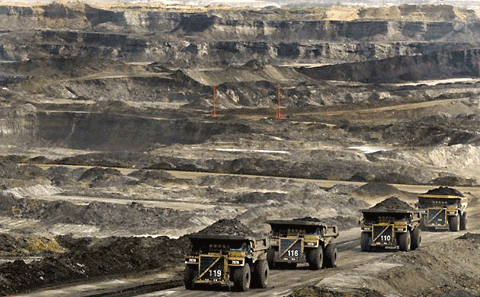
The Canadian tar sands have been touted as North America's answer to Saudi Arabia. With a current estimate of 172 billion barrels of reserves, it seems that they might be just that. But a closer look reveals obstacles that are likely to prevent the tar sands from ever reaching production rates close to that of Saudi Arabia, i.e., near 9 million barrels per day. First, oil from tar sands, unlike Saudi conventional oil, must be extracted from the sand to which it adheres. This is accomplished with huge amounts of water and heat. Approximately 6 tons of sand yield one barrel of oil.
Once separated from the sand, the residue remaining is not crude oil, but bitumen. It must be further processed by adding hydrogen which comes primarily from stripping the element from natural gas. This process also requires large amounts of energy.
The water used for separating the bitumen from the sand must be discharged to waste lagoons, which currently make up some of the largest man-made lakes in the world.
The tar sands produce about 1.3 million barrels of oil per day. They consume about one-quarter of Alberta's water supply to do so. Increasing production to 3 million barrels per day--which is already being projected--will require far more water and far more natural gas. Natural gas is in decline in Canada though more may become available if pipelines are brought from Alaska or the MacKenzie Delta in Canada's Northwest Territories, both of which have large natural gas resources. Alternatively, nuclear power plants could be built to provide the needed heat and hydrogen (through electrolysis of water).
Whatever path is chosen, huge investments would be called for, so financing becomes yet another bottleneck. Yes, the presumed reserves in the tar sands do rival those of Saudi Arabia, but it's not clear that they will ever be produced at so voluminous a rate.
Oil shale is another often touted major new source of oil. The resource estimates run up to 2.9 trillion barrels in place worldwide with 750 billion barrels in the United States alone. The total is more than twice all the known oil reserves in the world today. But as of yet, there is no commercial production. Methods tried so far require enormous amounts of energy to cook the shale to extract the hydrocarbons. What is extracted is not oil, but kerogen, an immature form of oil which must be further heated and then combined with hydrogen to get something equivalent to what we call crude oil. The source of the hydrogen? Either natural gas or electrolysis of water. Water is another key ingredient in the process, not primarily for its hydrogen content, but rather for other processing tasks. On the Colorado plateau, however, where the lion's share of the world's oil shale is found, there is precious little water to spare.
So tenuous is the future of oil shale that even the ever optimistic U. S. Energy Information Administration believes it will only contribute 140,000 barrels per day of production by 2030 out of a total expected U. S. daily consumption of 22.8 million barrels of liquid fuels.
Finally, there is natural gas from shale. There are huge resources in the shale layers of the Earth under the United States. And recently, drillers have had exceptional success using hydraulic fracturing to increase well flow from these shales. This has been a key advance in making this resource economical to produce. But, while the flow rates are high, they only persist at high rates for a year or two and then fall down to a very marginal level. That means that drillers will have to drill furiously both to replace depleting shale gas wells and add additional capacity if the aim is to grow the rate of production.
These requirements suggest several bottlenecks. Will there be enough drilling equipment and trained personnel to keep up with the ever-increasing rate of drilling needed to grow supplies from shale fields? Will pollution related to hydraulic fracturing limit how much of the resource can be exploited? And, will the necessary financing be available both to create the drilling and production infrastructure and to train the needed personnel?
(The other unknown for new oil and natural gas deposits, especially the unconventional ones discussed above, is whether prices will be sufficient to exploit a significant portion of the estimated resources. At $10 or $13 a thousand cubic feet, a huge amount of shale gas might be available. But not at $4. Similarly, at $100 a barrel, oil from tar sands and from shale, might loom considerably larger than at $50. But this is a size of the tank question and takes us away from our focus on the size of the tap.)
Just because the difficulties I've outlined above are many and challenging doesn't mean they can't be overcome. Anything is possible. But the optimists' case rests on the following premises: We will develop the necessary technology and somehow find or construct the means for the necessary ancillary resources (such as water and nuclear power) to exploit these unconventional sources of hydrocarbons. We will do this sufficiently soon to make up for the decline of conventional oil and natural gas supplies. And, we will do it at prices that won't derail the world economy. In addition, the financing will be there, and the facilities will get built in time to avert any extreme discontinuities in energy supplies. And finally, there won't be any side-effects that are sufficiently large--water pollution, for example--to prevent these developments.
Should we bet the entire future of the global economy on these premises just because the presumed size of the tank (read: resource) is so large? Or should we focus on prudent alternatives that don't depend on so many interlocking developments and that could be deployed now based on current technology?
Peak Oil : IEA's predictions seeming more and more infeasible with time
On November 9, the Uppsala University in Sweden published a report titled "The Peak of the Oil Age - The Uppsala World Energy Outlook". The report performs an analysis of the oil production forecast done by the International Energy Agency in 2008. One day before the release of the IEA 2009 edition of its World Energy Outlook report, the team of researchers notably pointed to a world oil supply in 2030 some 26 Mb/d lower than the IEA's predictions. Dr Michael Lardelli, one of the co-authors of the study, answers Scitizen's questions.
Oil Optimists Grow More Outlandish
As the troubling realities of future oil supplies begin to penetrate official circles, the oil optimists are making even more outlandish claims.
The Influence of "Peak Oil"
An article in the Washington Post this weekend, together with a must-read interview in The Independent, a paper I used to read regularly when I lived in London, reminded me of an observation I made several years ago concerning the similarities between Peak Oil and Y2K. Having spent a fair amount of time in my former corporate role planning for the serious outcomes the latter might have produced, I don't intend this as a slam on the former. Without rehashing the technical arguments behind either phenomenon, it's worth spending a few minutes thinking about the consequences of a growing belief that we might be only a few years away from the end of oil, as we know it. Whatever one's take on the validity of the Peak Oil argument, it has already evoked noteworthy consequences, both positive and negative.
The Fed and peak oil
Laurel Graefe, a senior economic researcher working for the Federal Reserve Bank of Atlanta has written an excellent overview of peak oil, “The Peak Oil Debate”. I consider this a must-read piece, as much for armchair oil experts as beginners, and as much for who published this as what it contains. This should be very high on your list of “brother-in-law” documents, the ones you can safely recommend to co-workers, neighbors, or, well, your brother in law.
Peak phosphate
The peak in conventional oil and gas production is not the only peak in the supply of natural resources to be confronted in the near future. It seems likely that the peak in conventional phosphate production from phosphate rock may also be near. A recent study of Cordell and coworkers, which is in press (1), suggests that ‘peak phosphate’ may occur between 2030 and 2040. ‘Peak phosphate’ may cause a shock. This is all the more so because oil and gas can be replaced by other means of energy supply, but phosphate is without a substitute.
Gap Oil
It is Gap Oil not Peak Oil that is the problem. Rising demand for oil will exceed the quantity of it that can be withdrawn from the earth, resulting in a supply-demand gap. Once production does peak the gap will be enlarged from both sides, drawing down the supply side against rising demand. This I suggest should be termed "Gap Oil". Energy efficiency and a reduction in our demand for oil is paramount and a growing dependence on what can be grown, to create a sustainable "bioeconomy".
Has Peak Oil Been Reached? No!
The Energy Watch Group released a report last week, stating that peak oil was reached in 2006. Scitizen sought the professional view of Dr Peter Jackson, Director of the CERA (Cambridge Energy Research Associates), whose position is that peak oil has not been reached. As well, we speak to Mr Jorg Schindler, the main author and Managing Director of Ludwig-Bölkow-Systemtechnik GmbH, about the report.
Has Peak Oil Been Reached? Yes!
The Energy Watch Group released a report last week, stating that peak oil was reached in 2006. Scitizen speaks to Mr Jorg Schindler, the main author and Managing Director of Ludwig-Bölkow-Systemtechnik GmbH, about the report. As well, we sought the professional view of Dr Peter Jackson, Director of the CERA (Cambridge Energy Research Associates), whose position is that peak oil has not been reached.
-
17/03/10
Are the health dangers from nuclear radiation exagerated?
-
03/03/10
Biofuels and land use
-
03/03/10
North Sea Oil and Gas may Provide One Third of Britain's Energy by 2020.
-
25/02/10
Do Texas and the North Sea Foretell the Future of Oil Production?
-
02/02/10
Is Hydrogen Research Driven by Fantasy?
| [1] | Comment by Chris Rhodes - 23 Jun, 2009 10:03 am Mainly it's a rate of flow (rate of recovery; rate of conversion) problem. Even if Richard Pike (CEO of the Royal Society of Chemistry) is right that there may be about 2.4 trillion barrels worth of crude oil to be recovered (i.e. twice as much as most other estimates give), if it can't be produced fast enough there will be a supply/demand gap. If oil production has indeed peaked (as many think) or is about to, then this restriction on supply is inevitable. Then we will be forced to modify our oil-dependent behaviour. I note that the EU is looking seriously at algae as a means for making biofuel, and there is a report to the effect that within 10 - 15 years this will become a commercial proposition. |
Alert Moderator
| |
| [2] | Comment by Nicholas - 23 Jun, 2009 10:47 am Well tar sand is not the answer to Canadian ever needed fuel supply. As it is costly and yet more research and development provision are needed to turn this sand into economical fuel resource. The major bottel neck in this whole project is of water. Drinking water resources are already coping with competition with industry growing demand. But alternative solution can be found by sewerage water. Yet another problem of purifying it. Too many ideas are discussed but yet to be agreed upon by all stakeholders. I am busy at the moment with my cisco certifications. Will pay visit on further development on this story. |
Alert Moderator
| |
| [3] | Comment by Bruce Pile - 28 Jun, 2009 12:30 am It is not only the flowrate that is more important than how much is there, it is also the stage of the recovery cycle that is more important than how much is there. People seem to turn a blind eye to the whole EROEI (Energy Returned On Energy Invested) thing, but if you dare look at the inescapable math of this, you see how vastly different the last half of oil's recovery is going to be from the first half. So much of that half that's left doesn't really matter! You can see this in the figures I have in my investing blog posts "The Coming Mystery Of The Missing Barrels Of Oil" and "The Alternative Energy No One Is Thinking About". View these charts only if you can stand a good scare. |
Alert Moderator
| |


Enlarge text
Reduce text size


Read more